System Architecture
Lertaro is built upon a multi-process isolation model and a layered architecture, ensuring sub-millisecond retrieval speeds and deep desktop integration while maintaining maximum system stability and security.
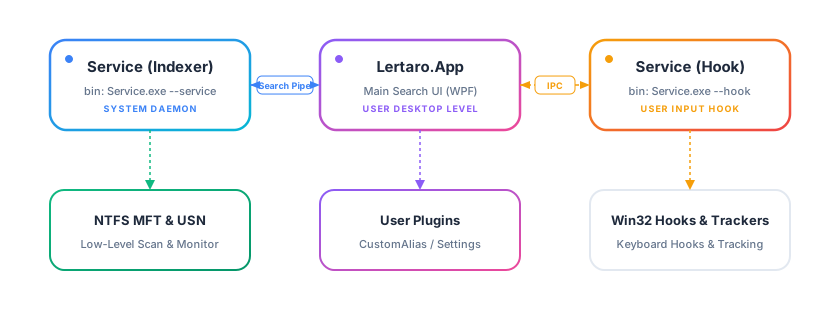
1. Three-Process Isolation Model
To prevent single component failures from crashing the entire system and to minimize elevated Windows privileges, Lertaro's runtime is decoupled into three independent processes:
1. Background Indexing Service (Lertaro.Service)
- Identity: Runs continuously as a Windows Service under the
LocalSystemaccount. - Responsibilities: Performs disk indexing and change tracking. Reads NTFS / ReFS USN Change Journals and $MFT tables; listens to FAT32 / exFAT change events; periodically crawls and caches SMB / NAS network shares.
- Security & Performance: Running at the SYSTEM level allows raw disk volume metadata access without prompting UAC dialogs, returning results to the user-mode App over high-speed named pipes while keeping the UI unprivileged.
2. User Interaction Application (Lertaro.App)
- Identity: Standard user-mode per-session WPF desktop application.
- Responsibilities: Hosts the centered Quick Search bar, Full Search window, Settings Center, global hotkey dispatching, action menus (
Ctrl+O), and QuickLook preview panels. - IPC Bridge & CLI Hosting: Communicates with the background service via bidirectional named pipes (
Core.Services.SearchService). It also hosts a dedicated per-user named pipe (AppSearchPipeService), allowing external tools like thelffCLI companion to reuse the App's initialized memory aliases, plugin providers, and cache trees without separate initialization.
3. Global Keyboard Hook & Window Adapter Process (Lertaro.Service --hook)
- Identity: Dedicated helper process launched with appropriate privileges by the background service.
- Responsibilities: Hosts low-level global keyboard hooks and mouse activity listeners.
- UIPI Bypass & Crash Isolation: Windows User Interface Privilege Isolation (UIPI) prohibits lower-integrity user applications from sending messages to elevated administrator windows. By hosting window adapters (
IActivePathCollector,IFileDialogAdapter,IInlineSearchAdapter) inside this process, Lertaro hooks into Administrator-run Explorers, Total Commander, and file dialogs seamlessly. Furthermore, anti-cheat hooks or crashes cannot bring down the main UI.
2. Shared Core Library (Lertaro.Core)
Lertaro.Core is referenced simultaneously by the Service, App, and Hook processes, containing:
- fzf Fuzzy Matching Engine (
Core/SearchIndex/Fzf/*): Optimized character jump matching, substring scoring, and highlight masks, coupled withSearchQueryParserfor drive letters and path tokens. - Columnar In-Memory Index (
Core/IndexV2/*): High-performance memory-mapped columnar snapshots with an in-memory delta overlay for sub-millisecond searches across hundreds of millions of files. - Binary IPC Protocols: Standard serialized message structures (
SearchRequestMessage, binary serializers) enabling zero-copy inter-process communication. - Multi-Process Logging (
Logger): Structured logging output toservice.log,app.log, andhook.log, presented uniformly within the Settings live log viewer.
3. Plugin Architecture & Lifecycle
All plugins are built on Lertaro.PluginSdk and dynamically loaded by Lertaro.App:
- Zero-Privilege Direct Access: Plugins interact exclusively with the App process. If a plugin requires custom directory indexing, it delegates requests through
DirectoryIndexerService. - Dual-Loading Mechanism: Search sources, actions, and UI components run solely in the App process; window and file dialog adapters (
IActivePathCollectoretc.) are also loaded into the Hook process to handle cross-integrity window automation.